Categories
Uncategorized

How to Increase Your IELTS Score: A Step-by-Step Guide

Preparing for the IELTS exam can feel like standing at the base of a tall mountain — exciting, yet a bit overwhelming. Whether you’re planning to study abroad or aiming for permanent residency, that band score holds real power.  That high band score isn’t just a number; it’s the key that unlocks your future.

This guide will walk you through practical ways to improve your IELTS score — with focus, strategy, and confidence.


1. Start with the Right Mindset

Many test-takers make one big mistake: treating IELTS as just an exam. In reality, it’s a measure of your ability to communicate naturally in English.
Instead of worrying about scores, focus on becoming a confident English user. When communication improves, your score follows.

Try this first:
Take a full-length mock test under timed conditions. It gives you a clear idea of your current level — your strengths, weaknesses, and where to direct your effort next.

2. Master the Four Modules with Smart Strategies

IELTS assesses you on four skills — Listening, Reading, Writing, and Speaking. Each requires its own approach.

Listening & Reading: Speed, Strategy, and Focus


      • Skim and scan. Don’t read every word. Learn to locate key ideas and keywords quickly.

      • Expose your ears. Listen to podcasts, news, or shows in different accents — British, Australian, American.

      • Accuracy matters. Always double-check spellings and answers when transferring them to your sheet.

    Writing & Speaking: Clarity and Expression


        • Structure your writing. Organize your thoughts clearly — Introduction, Body, Conclusion.

        • Use complex sentences. Mix short and long structures to show grammatical range.

        • Speak naturally. Record yourself answering common IELTS topics. Don’t memorize; aim for fluency and coherence. Use the “Point → Explanation → Example” method to expand your answers.

      3. Build Vocabulary the Smart Way

      A strong vocabulary isn’t about memorizing difficult words — it’s about using the right words naturally.


          • Learn by topic. Focus on common IELTS themes like environment, technology, and education.

          • Practice paraphrasing. Restate sentences in your own words while keeping the same meaning — it’s a key skill in Reading and Writing.

          • Stay consistent. Study English daily for 30–45 minutes instead of long, irregular sessions. Consistency beats intensity.

        4. Practice with Purpose

        IELTS success doesn’t come from endless studying — it comes from smart, focused practice.


            • Take timed tests weekly to track progress.

            • Review your mistakes carefully to understand why they happened.

            • Don’t just learn — apply what you learn in real-life English use (conversation, journaling, etc.).

          Remember, IELTS is just one step in your journey to studying, working, or settling abroad. The key is to stay patient, positive, and persistent. Every practice session brings you closer to your goal.

          Final Thoughts

          Improving your IELTS score is about growth — not just in English, but in confidence and discipline. Approach the process with curiosity, consistency, and self-belief.

          Whether your goal is a study visa or permanent residency, your dream is achievable with the right mindset and preparation.

          Your high band score isn’t far away — it’s waiting at the end of your consistent effort.

          Want to Study or Settle Abroad?

          If you’re planning to apply for a study visa or Permanent Residency (PR), professional guidance can make the process smoother and more successful.
          Contact Migratex for expert advice on the best immigration pathways and a clear roadmap to achieving your global goals.
          Categories
          Visa consultant in europe

          Nursing in Europe (Bulgaria, Georgia, Albania) – Lowest Fees, No IELTS Required, and a Pathway to Settle in Europe

          If you’ve always dreamed of working and settling in Europe as a Registered Nurse, this could be your golden opportunity. European countries like Bulgaria, Georgia, and Albania have become top choices for international nursing aspirants — thanks to their low tuition fees, English-taught programs, No IELTS requirement and Free German and Italian Language Training.

          Let’s understand why studying nursing in these countries is one of the smartest career moves you can make.

          1. Why Choose Nursing in Europe?

          Europe has always been known for its high-quality healthcare education and global recognition of nursing qualifications. Many European universities provide practical-based learning, advanced simulation labs, Hospitals, patients interactions and international exposure that prepares students to work anywhere in the world.

          The demand for qualified nurses in Europe is increasing rapidly. With an ageing population and healthcare expansion, countries across the continent are actively welcoming trained nurses — especially from India and Asia.

          2. Study Nursing in Bulgaria, Georgia, and Albania

          These three countries are becoming hidden gems for nursing education:

          Bulgaria

          Bulgaria offers one of the low tuition fees in Europe with English-medium programs. Nursing courses are approved by the European Union, allowing graduates to work across EU countries after registration.

          Georgia

          Georgia is popular for its world-class universities, safe environment, and affordable living costs. Nursing programs here focus on both theoretical and hands-on training, making it ideal for students who wish to settle in Western Europe later.

          Albania

          Albania is gaining attention for its European-standard curriculum and lowest cost of education with Free German and Italia Languages. Albania  The best part — students can apply for Permanent Residency or work in any EU country after meeting the licensing criteria.

          Key Benefits for International Students

          1. Low Tuition & Living Costs

          Compared to Western Europe or the US, Bulgaria, Georgia, and Albania offer highly affordable education options without compromising on quality.

          2. No IELTS Requirement

          Most universities accept students who studied in English-medium institutions, so IELTS is often not mandatory.

          3. Globally Recognized Degrees

          A nursing degree from these countries can open doors to careers across Europe and beyond, especially if your institution follows EU standards.

          4. Hands-on Clinical Training

          All programs include practical hospital training, ensuring you graduate with real-world experience.

          5. Pathway to European Settlement

          Graduates can apply for registration as nurses in other European countries, creating a clear path for career growth and permanent settlement.

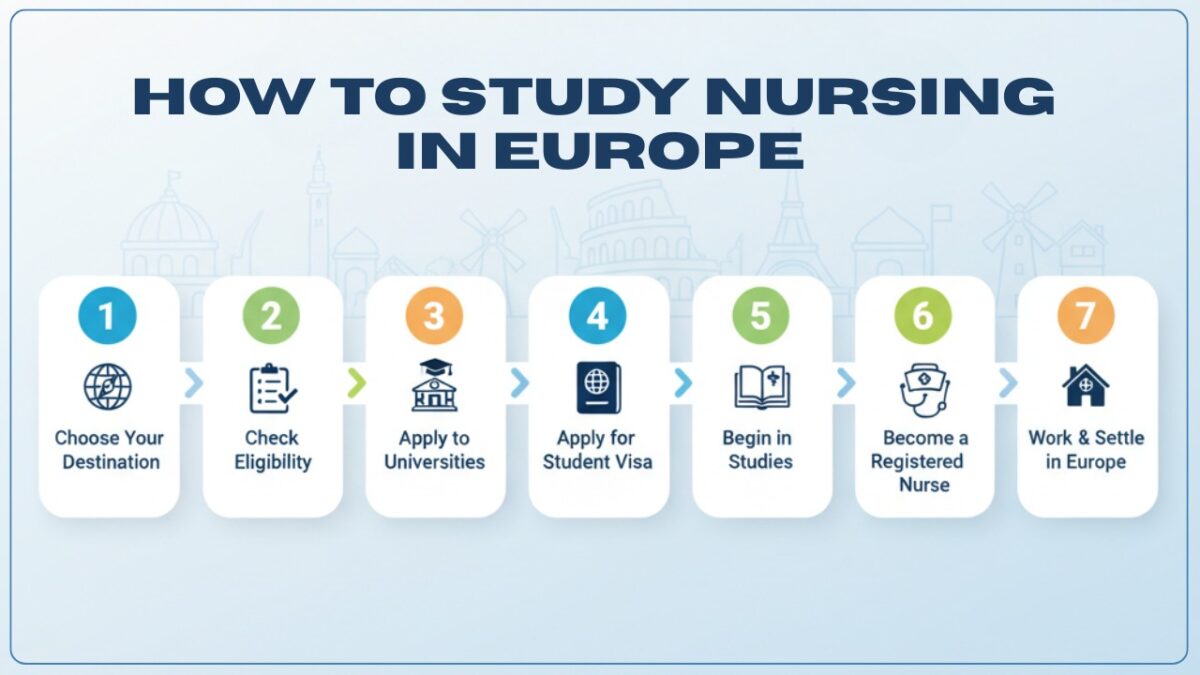
          How to Study Nursing in Europe

          Facts You Should Know

            • A Bachelor’s degree in Nursing usually takes 3–4 years.

            • Degrees from EU countries like Bulgaria offer easier recognition across Europe.

            • English is the medium of instruction in universities.

            • Many institutions provide scholarships and student exchange programs.

            • Living costs are far lower compared to Western Europe, making it budget-friendly for international students.


          Career and Settlement Opportunities

          After completing your nursing degree, you can:

            • Work in hospitals, clinics, and healthcare organizations across Europe.

            • Apply for EU nursing registration after necessary documentation.

            • Continue advanced studies like Master’s or specialized nursing courses.

            • Settle permanently in your country of employment after meeting residency requirements.

          FAQs

          Q1. Do I need IELTS to study nursing in Europe?
          Not necessarily. Many universities in Georgia and Albania don’t require IELTS if you’ve studied in English earlier.

          Q2. What is the total cost of studying nursing in these countries?
          On average, you can expect €2,500 to €5,000 per year in tuition fees and around €300–€600 per month for living expenses.

          Q3. Can I work while studying?
          Yes, most European countries allow part-time work during your studies, helping cover living costs.

          Q4. Will my degree be valid in other European countries?
          Yes, if you study at a recognized university, your degree will be valid across the EU and other European regions.

          Q5. Can I settle in Europe after completing my nursing course?
          Yes. Once you’re licensed and gain professional experience, you can apply for long-term residence or permanent settlement depending on local immigration rules.

          Conclusion

          Studying nursing in Bulgaria, Georgia, or Albania is an excellent opportunity for students who dream of a rewarding healthcare career in Europe. With low fees, no IELTS, and a clear pathway to settlement, these destinations offer both quality education and long-term stability.

          If you’re planning your next step, reach out to Migratex Study abroad Global Consultant, a trusted Schengen study visa consultant in Bangalore, to guide you through every step — from application to arrival.

          Categories
          Immigration Consultant

          What is a Schengen Study Visa?

          Studying in Europe has become a dream for thousands of Indian students, and the gateway to that dream often begins with a Schengen Study Visa. If you’ve ever thought about pursuing your higher education in countries like Germany, France, Spain, or the Netherlands, understanding this visa is the first step toward making that dream a reality.

          Understanding the Schengen Study Visa

          A Schengen Study Visa allows international students to study in one of the 27 Schengen countries. With this visa, you are permitted to live, study, and sometimes even work part-time in the country of your choice.

          The main advantage? Once you hold a Schengen Visa, you can travel freely across the Schengen Zone without applying for multiple visas. This is especially helpful for students who want to attend academic conferences, explore Europe, or even consider exchange programs in other countries.


          Why is the Schengen Study Visa Popular Among Indian Students?

          1. Access to Top Universities – Countries like Germany and France are home to some of the world’s leading institutions.
          2. Affordable Education – Compared to countries like the USA or Australia, many European countries offer lower tuition fees such as latvia, poland & malta. Germany and Austria even have tuition-free universities for international students.
          3. Travel Opportunities – With a single visa, you can explore cultural and professional opportunities across all the European countries.
          4. Career Benefits – Many Schengen countries allow post-study work visas or Stay back, giving students a chance to gain international exposure plus PR options.

          According to The Indian Express, the number of Indian students choosing Europe has seen a steady rise, with Germany, France, and Ireland becoming top destinations for higher education.


          Documents Required for a Schengen Study Visa

          While requirements vary slightly by country, here are the general documents you’ll need:

          • Valid passport with at least 6 month Validity and two blank pages
          • Admission letter from a recognized university in a Schengen country
          • Proof of financial resources (bank statements or scholarship letters)
          • Proof of accommodation (university hostel or rental agreement)
          • Travel insurance with coverage of at least €30,000
          • Visa application form and passport-sized photographs

          It’s always advisable to start your application well in advance, as the process can take several weeks.


          Common Challenges Students Face

          Many students believe that applying for a Schengen Study Visa is complicated, but with the right guidance, the process becomes smooth. Some common challenges include:

          • Understanding country-specific requirements
          • Proof of funds (especially when applying to tuition-free universities)
          • Visa interview preparation

          This is where seeking the right guidance from experts matters. Working on your study visa with Migratex Study abroad, a trusted Schengen visa consultant in Bangalore ensures that your application is accurate, complete and on time.

          Why Choose Migratex Study Abroad Global Consultant?

          At Migratex, we’ve guided hundreds of students in successfully obtaining their Schengen Study Visa. From helping you understand eligibility to preparing for interviews, our team ensures that no detail is missed.

          • Personalized counseling for your chosen university and country
          • Step-by-step support with documentation
          • Assistance with financial planning and travel guidance
          • Complete support even after your visa is approved

          If you’re searching for the right Schengen study visa consultant in Bangalore, Migratex stands as one of the most trusted names in the field.

          Explore our Study Abroad Services for more details. 
          Looking to apply for PR in Europe? We can help with that too.

          Quick Facts About Schengen Study Visa

          • Covers 27 countries, including popular destinations like Germany, France, and Spain
          • Usually valid for the duration of your study program
          • Allows part-time work in many Schengen nations (up to 30 hours a week in most cases)
          • Processing time: typically 3–8 weeks, depending on the country

          FAQs

          1. Can I work while studying on a Schengen Study Visa?
          Yes, most Schengen countries allow students to work part-time (20–30 hours per week).

          2. How early should I apply for a Schengen Study Visa?
          At least 2–3 months before your program begins, to avoid delays.

          3. Is travel insurance mandatory?
          Yes, with coverage of at least €30,000, valid across the Schengen Zone.

          4. Do all Schengen countries have the same rules?
          No, each country has specific guidelines, so always check the embassy website of your destination country.

          Categories
          Immigration Consultant

          What is University QS World Ranking?


          When students plan to study abroad, one of the first things they look for is the reputation of the university. Among the many ranking systems available, the QS World University Rankings is one of the most trusted and globally recognized. It serves as a benchmark for academic excellence and helps students make informed decisions about their education and career path.

          Whether you are applying to universities in Europe, the UK, Canada, or the US, understanding the QS World Ranking can give you an edge when selecting the right university.

          Understanding the QS World University Rankings

          The QS World University Rankings is an annual ranking of the world’s top universities, published by Quacquarelli Symonds (QS), a British company specializing in education and study abroad. Since its launch in 2004, it has become one of the most influential rankings, helping students identify universities known for quality education, research, and global recognition.

          These rankings cover more than 1,500 universities worldwide and evaluate them based on various key indicators to ensure a fair and comprehensive assessment.


          Key Factors Used in QS World Rankings

          The QS system evaluates universities across six main criteria:

          1. Academic Reputation (40%)
            Surveys thousands of academics worldwide to measure the perceived quality of teaching and research at a university.
          2. Employer Reputation (10%)
            Employers are asked to identify institutions that produce the most employable graduates.
          3. Faculty/Student Ratio (20%)
            Measures the quality of teaching by calculating the number of faculty members per student.
          4. Citations per Faculty (20%)
            Reflects the impact of research by counting how often published work is cited globally.
          5. International Faculty Ratio (5%)
            Shows how diverse and globally connected a university’s teaching staff is.
          6. International Student Ratio (5%)
            Indicates how welcoming and inclusive the university is to students from around the world.

          These factors provide a balanced view of academic strength, research influence, and global appeal.

          Why QS Rankings Matter to Students

          For students planning to study abroad, the QS World Ranking acts as a reliable guide when comparing universities. Here’s why it’s important:

          • Credibility: QS rankings are globally respected and recognized by universities, employers, and governments.
          • Better Career Opportunities: Graduating from a top-ranked university can enhance your resume and increase job prospects.
          • Quality Assurance: High-ranking universities usually offer advanced facilities, strong research programs, and experienced faculty.
          • Global Exposure: Institutions with high international faculty and student ratios promote cultural diversity and global networking.

          QS Rankings 2025 – A Quick Glimpse

          Each year, QS releases its updated list featuring global leaders like MIT, Oxford, Harvard, and Cambridge, as well as emerging universities from Europe and Asia. For Indian students, universities such as the Indian Institute of Technology (IIT) Bombay and Delhi University also feature in these rankings, reflecting India’s growing presence on the world education map. You can explore the full methodology and details on the QS official site.

          How Migratex Study Abroad Can Help You Choose the Right University

          While the QS World Ranking provides valuable insights, choosing the right university is about more than just numbers. Factors like course structure, cost of living, scholarships, and study visa requirements also play a critical role. This is where Migratex Study Abroad– the best study and immigration consultant in Bangalore can guide you.

          Our team helps students:

          • Shortlist universities based on QS rankings, course preferences, and career goals.
          • Prepare a strong Study Proposal, SOP along with the application to increase acceptance chances.
          • Navigate students with proper interview support and visa processes for countries like Europe, the UK, Canada, and Australia.

          With Migratex study Abroad, you can be confident that your decision is informed, strategic, and aligned with your future career plans.

          Tips for Students Using QS Rankings

          1. Don’t Rely Only on Rankings: Consider course content, city, budget, and work opportunities alongside QS data.
          2. Check Subject-Wise Rankings: Some universities may not be in the top 100 overall but excel in specific programs.
          3. Look at Year-on-Year Trends: Consistent performance indicates stability in quality.

          Final Thoughts

          The QS World University Rankings are a powerful tool for students planning to study abroad, offering an authentic evaluation of universities worldwide. However, your choice should combine ranking insights with personal preferences, budget, and career aspirations.

          For expert guidance in selecting the best-fit university and managing visa requirements, Migratex – the best Study and immigration consultant in Bangalore is here to simplify the process and help you achieve your global education dream.

          For your more queries please contact Migratex Global Consultant

          Categories
          Immigration Consultant

          Why Europe is a Safe Destination for Indian Students in 2025 – 2026 intake

          Studying abroad is a life-changing decision, and for Indian students in 2025- 2026, Europe continues to be one of the safest and most rewarding destinations. From world-class universities to diverse cultural experiences and strong career prospects, Europe offers the perfect blend of quality education, personal growth and life settlement. If you’re planning to study in Europe, partnering with an experienced Europe study visa consultant in Bangalore can make the entire process smooth and stress-free.


          1. Strong Safety Standards and Welcoming Environment

          Europe is known for its high safety standards, progressive laws, and student-friendly environment. Countries such as Germany, France, Netherlands, Spain and Malta consistently rank high in global safety indexes and provide excellent student support services. From well-maintained infrastructure, public transport to strict regulations for student welfare, Europe ensures a secure lifestyle for international students.

          Indian students also find Europe culturally inclusive, with vibrant Indian communities, Indian restaurants, and regular cultural festivals like Diwali,Holi,ugadis , Eid, Christmas that create a sense of belonging.

          2. Quality Education at Affordable Costs

          European universities are among the best in the world, offering programs that focus on research, innovation, and practical learning. Public universities in countries like Germany, Austria, Norway and Latvia provide low-cost or even tuition-free education, while scholarships and grants make it easier for Indian students to pursue their dream courses without financial burden. For detailed country-wise requirements, check our Study in Europe Guide.

          3. Post-Study Work Opportunities

          Europe’s post-study work policies are becoming increasingly favorable. Countries like France, Germany, and Ireland allow international students to stay back for up to 18–24 months after graduation to seek employment. With a strong economy and demand for skilled professionals, Europe provides excellent career growth opportunities.

          4. Easy Visa and Immigration Process

          With proper guidance from a trusted visa consultant for Europe, Indian students can navigate the application process with ease. From selecting the right university to preparing visa documents and interview preparation, the right consultant ensures a hassle-free journey. Agencies like Migratex – one of the best Study Abroad immigration consultants in Bangalore specialize in Europe student visa assistance, helping students avoid common mistakes and ensuring higher success rates.

          5. Exposure to Diverse Cultures

          Europe is home to 44 countries, each offering unique languages, traditions, and lifestyles. Studying in Europe means exploring historical cities, world-famous landmarks, and a multicultural atmosphere that enhances global exposure and personal development. Learn more about scholarships and study options directly from Study in Europe (EU Official Site).

          How to Plan Your European Education Journey


              1. Choose Your Country & Course – Decide based on your field of interest, tuition fees, and job prospects.

              1. Prepare Your Documents – Academic transcripts, language test scores (like IELTS/TOEFL),Strong SOP , LOR and financial proof are essential.

              1. Apply Early – European universities have strict deadlines; applying 4–6 months before intake is recommended.

              1. Consult Experts – Work with an experienced Europe visa consultant in Bangalore for a seamless process.

            Why Choose Migratex – Your Trusted Europe Study Visa Consultant in Bangalore


                • Personalized Guidance: From course selection to visa documentation, every step is tailored to your needs.

                • High Success Rate: Our expert team ensures error-free applications for faster approvals.

                • End-to-End Support: From admission to pre-departure briefings and Post-Landing services,  Migratex assists you throughout the journey.

              As the best immigration consultant, Migratex ensures that your European education dream turns into reality without unnecessary stress.

              FAQs on Studying in Europe for Indian Students

              1. Is Europe safe for Indian students in 2025?
              Yes. European countries maintain high safety standards, strict laws, and provide dedicated student support services, making it one of the safest destinations for Indian students.

              2. Do I need IELTS to study in Europe?
              Not always. Many universities accept Indian students based on medium-of-instruction certificates or other English proficiency tests.

              3. What is the cost of studying in Europe?
              Tuition fees vary by country. Public universities in Germany, Austria and Norway are almost free, while others may range from €3500–€15,000 per year.

              4. Can I work while studying in Europe?
              Yes. Most European countries allow international students to work part-time for 20 hours a week during the semester and full-time during vacations.

              5. How can a visa consultant help me?
              A visa consultant for Europe assists with admission guidance, country selection, course shortlisting, Application, financial documentation, visa filing, and interview preparation to increase your chances of approval.

              Final Thoughts

              For Indian students seeking a safe, affordable, and globally recognized education in 2025- 2026, Europe remains an unbeatable choice. With the right planning and expert guidance from Migratex – the best study abroad and migration consultant in Bangalore, your dream of studying in Europe can become a smooth and successful journey.For your more queries please contact Migratex Global Consultant

              Categories
              Immigration Consultant

              Permanent Residency vs. Work Permit: Which Option is Right for You?

              Thinking of moving abroad can be exciting—but choosing the right immigration pathway can feel confusing. Many people struggle to decide between a Work Permit and Permanent Residency (PR).

              At Migratex, our team is dedicated to personalized guidance, ensuring each client gets the attention and support they need to make the best decision for their career and life abroad.

              What is a Work Permit?

              A Work Permit allows you to live and work in a foreign country for a limited time. It’s usually tied to a specific job or employerKey Features:


                • Temporary Status: Usually 1–3 years, depending on the country.

                • Job-Specific: Restricted to a certain employer or role.

                • Limited Benefits: Some social services and benefits may not be available.

              Who Should Consider a Work Permit?


                • Students or interns gaining international work experience.

                • Short-term job seekers who plan to return or transition later.

              Popular destinations include Canada, Australia, Finland, Germany, New Zealand, Ireland, Sweden, UAE etc.

              What is Permanent Residency (PR)?

              Permanent Residency (PR) lets you live and work in a country indefinitely. PR holders enjoy almost all benefits of citizens, except voting rights in some countries.


              Key Features:

                • Long-Term Stability: Live and work without frequent renewals.

                • Employment Freedom: Work for any employer or start your own business.

                • Social Benefits: Access to healthcare, education, and welfare programs.

              Who Should Consider PR?

                • Professionals and families looking for long-term settlement.

                • People planning to eventually apply for citizenship.

                • Individuals wanting security and better opportunities abroad.

              Popular countries offering PR include Canada, Australia, Finland, Germany, and New Zealand etc.


              Work Permit vs. Permanent Residency: Quick Comparison

              Feature Work Permit Permanent Residency (PR)
              Duration Temporary (1–3 years) Permanent
              Employment Flexibility Tied to employer Freedom to choose
              Benefits Limited Extensive
              Pathway to Citizenship Usually no Often yes after certain years
              Family Sponsorship Sometimes limited Can sponsor family members
              Renewal Required Not required

              Things to Consider Before Choosing


                • Your Career Goals: Are you looking for a short-term job or long-term settlement?

                • Family Situation: PR is better if you want to bring family members.

                • Financial Planning: PR may cost more upfront but provides long-term stability.

                • Country Rules: Immigration policies vary—expert guidance is key.

              How Migratex Helps You

               As a best immigration consultant in Bangalore, at Migratex we understand that each migration journey is unique. Being a small consultancy means we give personalized attention to every client:


                • Assessing your eligibility for Work Permits or PR.

                • Guiding you through paperwork, documentation, and timelines.

                • Helping you understand benefits and long-term opportunities.

                • Offering support even after you settle abroad.

              FAQ’S

              What is the main difference between a Work Permit and Permanent Residency (PR)?

              A Work Permit is a temporary authorization to live and work in a country for a specific employer or job, while Permanent Residency (PR) allows you to live, work, and settle in a country indefinitely with most of the rights of a citizen.

              Which is easier to get: PR or a Work Permit?

              Generally, a Work Permit is faster and easier to obtain because it’s employer-based and requires fewer eligibility criteria. Permanent Residency, on the other hand, takes longer as it involves a points-based system, skill assessments, and stricter requirements.

              Can I apply for PR after getting a Work Permit?

              Yes. In many countries like Canada, Australia, and Germany, you can apply for PR after gaining work experience on a valid Work Permit, provided you meet the country’s PR criteria.

              Which option is better for families?

              Permanent Residency (PR) is better for families because it allows you to sponsor your spouse and children, access social benefits, and settle permanently without frequent renewals.

              How long does it take to get a Work Permit or PR?

              Processing times vary by country and category. A Work Permit can take a few weeks to a few months, while PR can take 6–18 months depending on the immigration program and your profile.

              Can I change jobs on a Work Permit?

              In most countries, a Work Permit is tied to a specific employer or job. Changing jobs usually requires a new permit. With PR, you are free to work for any employer or start your own business.

              Which countries are best for PR in 2025?

              Top destinations for PR in 2025 include Canada, Australia, Finland, Germany, and New Zealand because of their stable economies, quality of life, and strong immigration programs.

              Conclusion

              Choosing between a Work Permit and Permanent Residency is a life-changing decision. While a Work Permit offers temporary employment flexibility, PR provides long-term security, benefits, and freedom.

              Migratex is committed to guiding you step by step, making the process smooth, simple, and stress-free.Call us now: +91-9739738883
              book your free consultation to get started!

              Categories
              Immigration Consultant

              Top Countries to Migrate in 2025: Opportunities, PR Pathways & Job Markets

              Are you planning to move abroad in 2025? Whether you’re seeking better career prospects, world-class education, or a high standard of living, now is the perfect time to explore the best destinations for migration. With evolving immigration policies and global talent demand, choosing the right country can set you on the path to success.


              In this blog, we’ll explore the top countries to migrate in 2025, including European destinations, and how working with the best immigration consultant in Bangalore – Migratex Global Consultants – can make your journey seamless.


              Quick Overview: Top Countries to Migrate in 2025

              CountryPopular PR/Work PathwaysHot Job SectorsKey Benefits
              CanadaExpress Entry, PNPIT, Healthcare, Engineering, FinanceFree healthcare, strong job market, family-friendly
              AustraliaSkilled Independent Visa (189), State Nomination (190)Healthcare, IT, ConstructionHigh quality of life, points-based PR
              United Kingdom (UK)Skilled Worker Visa → ILRHealthcare, Finance, EducationTop universities, global job opportunities
              GermanyEU Blue Card, Skilled Immigration ActIT, Automotive, EngineeringLow-cost education, strong economy
              FranceTalent Passport, EU Blue CardTech, Hospitality, FashionCultural lifestyle, social benefits
              FinlandWork-Based Residence Permit, EU Blue CardIT, Clean Energy, HealthcareFamily-friendly, free education
              NetherlandsHighly Skilled Migrant Visa, EU Blue CardData Science, Fintech, LogisticsHigh English proficiency, expat-friendly
              PortugalGolden Visa, D7 VisaTourism, Tech Startups, Renewable EnergyAffordable living, EU residency access
              New ZealandSkilled Migrant Category, Work-to-Residence VisaAgriculture, IT, HealthcareBeautiful landscapes, safe & family-friendly
              UAEGolden Visa, Skilled Worker VisaFinance, Real Estate, HospitalityTax-free income, global business hub

              1.New Zealand: Safe, Scenic & Skilled

              New Zealand offers a peaceful lifestyle with strong PR options.

              • PR Pathways: Skilled Migrant Category, Work-to-Residence Visa.
              • Hot Jobs: Agriculture, IT, healthcare, construction.

              Perks: Beautiful landscapes, safe environment, and family-friendly policies.

              Canada: The Land of Opportunities

              Canada remains one of the most sought-after destinations for Indian immigrants.

              • PR Pathways: Express Entry, Provincial Nominee Program (PNP), Family Sponsorship.
              • Hot Jobs: IT, healthcare, finance, and engineering.
              • Why Move Here? Free healthcare, strong economy, safe cities, and excellent education for children.

              💡 Pro Tip: A higher IELTS score and relevant work experience can boost your Express Entry CRS points and fast-track your PR application.


              Australia: Points-Based Migration Made Easy

              Australia attracts skilled professionals with its transparent points-based immigration system.

              • PR Pathways: Skilled Independent Visa (189), State Sponsored Visa (190).
              • Hot Jobs: IT, healthcare, construction, engineering.
              • Perks: High quality of life, multicultural environment, and globally recognized education.


              United Kingdom (UK): Work & Study Hub

              Post-Brexit, the UK has simplified its skilled migration system.

              • PR Pathways: Skilled Worker Visa leading to Indefinite Leave to Remain (ILR).
              • Hot Jobs: Healthcare, finance, education, hospitality.
              • Perks: Access to top universities, international career growth, and global work exposure.

              Germany: Europe’s Economic Powerhouse

              Germany offers a strong economy and structured migration pathways for skilled workers.

              • PR Pathways: EU Blue Card, Skilled Immigration Act.
              • Hot Jobs: IT, automotive, engineering, healthcare.
              • Perks: Free or low-cost university education and high living standards.

              France: Culture Meets Career

              France is attracting global talent with its tech-friendly and business-friendly policies.

              • PR Pathways: Talent Passport, EU Blue Card.
              • Hot Jobs: Technology, hospitality, fashion, education.
              • Perks: Excellent social security, rich cultural experience, and family benefits.

              Finland: Work-Life Balance at Its Best

              Finland is among the happiest and safest countries in the world, making it ideal for families.

              • PR Pathways: Work-Based Residence Permit, EU Blue Card, Startup Permit.
              • Hot Jobs: IT, healthcare, clean energy, engineering.
              • Perks: Free education, family-friendly policies, and strong social security.

              Netherlands: Expats’ Favorite

              The Netherlands is known for its progressive economy and expat-friendly policies.

              • PR Pathways: Highly Skilled Migrant Visa, EU Blue Card.
              • Hot Jobs: Data science, fintech, logistics, IT.
              • Perks: High English proficiency, great work-life balance, and robust expat support.

              Portugal: Affordable & Accessible Europe

              Portugal combines low living costs with EU residency benefits, perfect for remote workers and investors.

              • PR Pathways: Golden Visa, D7 Visa.
              • Hot Jobs: Tech startups, tourism, renewable energy.
              • Perks: Affordable living, access to Schengen area, and safe neighborhoods.

              UAE: Tax-Free Income & Global Exposure

              The UAE is ideal for professionals seeking high-paying, tax-free opportunities.

              • PR Pathways: Golden Visa, Skilled Worker Visa.
              • Hot Jobs: Finance, IT, real estate, hospitality.
              • Perks: Strategic business hub, modern infrastructure, and multicultural environment.

              How to Choose the Right Country

              When deciding your migration destination, consider:

              • Job demand in your field
              • Visa/PR eligibility and processing time
              • Cost of living and lifestyle
              • Language and cultural adaptability


              Why You Need a Trusted Immigration Consultant

              Immigration rules are constantly changing, and mistakes can lead to delays or visa rejection. Working with the best immigration consultant in Bangalore, like Migratex Global Consultants, ensures:

              • Expert guidance for Canada PR, Australia immigration, and Europe migration visas
              • Proper document preparation and submission
              • Interview guidance and PR application support

              With Migratex Global Consultants, your migration journey becomes smooth, fast, and stress-free.

              Final Thoughts

              From Canada’s Express Entry to Finland’s Work-Based Residence Permit, 2025 is full of opportunities for skilled professionals, students, and families.
              For a hassle-free immigration experience, trust Migratex Global Consultants – the best immigration consultant in Bangalore – to turn your dream of living abroad into reality.

              Categories
              Immigration consultant for australia

              SOP for Australia Universities: How to Write a Winning Statement of Purpose in 2025

              Applying to study in Australia is an exciting journey, but one document can make or break your application—the Statement of Purpose (SOP).
              Whether you are applying for a Bachelor’s, Master’s, or a Student Visa (Subclass 500), a well-crafted SOP convinces both the university and the visa officer that you are a serious, genuine student.

              In this guide, we’ll cover everything you need to know about writing a perfect SOP for Australian universities, including format, key elements, tips, and a checklist to help you stand out.

              What Is an SOP for Australian Universities?

              An SOP (Statement of Purpose) is a personal essay that explains:


                • Your academic background

                • Career goals

                • Reason for choosing Australia

                • Why you selected a specific course and university

                • Your future plans after graduation

              Think of it as your story. Australian universities use it to evaluate your motivation, clarity of purpose, and eligibility.

              Why SOP Is Important for Australia

              Unlike many countries, Australian universities and visa officers assess both your academic intent and genuine temporary entrant (GTE) requirement through the SOP.
              A strong SOP:


                • Strengthens your admission chances

                • Supports your Student Visa application

                • Demonstrates financial & career clarity

              Ideal SOP Format for Australia

              While each university may have its own guidelines, a standard SOP should be 800–1,000 words and include the following sections:

              1. Introduction (Hook + Purpose)


                • Start with a powerful opening—a personal story, a career ambition, or an inspiration.

                • Clearly state the program and university you are applying to.

              2. Academic Background


                • Highlight your educational qualifications, key projects, or internships.

                • Mention academic achievements relevant to your chosen course.

              3. Professional Experience (if any)


                • Share details of work experience, internships, or research.

              4. Why Australia?


                • Discuss why you chose Australia over other countries.

                • Highlight Australia’s quality education, global recognition, and work opportunities.

              5. Why This University and Course?


                • Mention specific faculty, research opportunities, curriculum modules, or campus facilities.

                • Show that you have researched the university well.

              6. Career Goals


                • Explain short-term and long-term career plans.

                • Link your course to your future job prospects in India or globally.

              7. Financial Capability


                • Briefly mention that you have sufficient funds to support your education and stay.

              8. Conclusion


                • Reiterate your commitment to return to your home country after studies (important for visa approval).

                • End with a positive, confident statement.

              Sample Opening for SOP (Australia)

              “Growing up in a family of entrepreneurs, I was fascinated by how businesses adapt to changing markets. My passion for analytics and strategic planning inspired me to pursue a Master’s in Business Analytics at the University of Melbourne. With Australia’s globally recognized education system and strong industry connections, I am confident this program will help me develop advanced analytical skills and achieve my goal of becoming a data-driven business strategist.”

              Expert Tips to Write a Perfect SOP for Australia

              Stay Genuine: Never copy from online samples.
              Be Concise: Stick to 2–3 pages maximum.
              Highlight GTE Points: Show your intention to return home.
              Proofread Thoroughly: Check grammar, spelling, and formatting.
              Use Simple English: Avoid jargon or overly complex words.
              Add Evidence: Support claims with achievements, internships, or projects.

              Common Mistakes to Avoid

              Using generic templates
              Focusing only on academics and ignoring career plans
              Exceeding the word limit
              Failing to justify your course and university choice
              Forgetting the GTE requirement for visa

              FAQs on SOP for Australia Universities

              Q1. What is the ideal length of an SOP for Australian universities?
              800–1,000 words or around 2 pages is ideal.

              Q2. Can I use the same SOP for all universities?
              No. Customize each SOP to match the specific university and course.

              Q3. Do I need a different SOP for the Australian Student Visa?
              Yes. Your visa SOP must emphasize financial stability and return plans.

              Q4. Is plagiarism checked in SOPs?
              Yes. Always write an original statement.


              Final Checklist Before Submitting Your SOP


                • Proper structure (Introduction–Body–Conclusion)

                • Course & university clearly mentioned

                • Proof of financial and career clarity

                • GTE compliance highlighted

                • Free from grammar and spelling errors

              Need Help Writing Your SOP?

              Writing an SOP that impresses both universities and visa officers can be challenging.
              At Migrate, our experts craft custom SOPs that reflect your goals, meet university guidelines, and strengthen your student visa application.

               Contact MigrateX today to get your professional SOP for Australia and make your dream of studying in Australia a reality.

              Categories
              Immigration consultant for canada in Bangalore

              Canada to Introduce New Express Entry Categories in 2026

              A new chapter in Canadian immigration may begin in 2026—and skilled professionals could be the ones stepping through the door. If you’re following Canada immigration news, this is an update you don’t want to miss.

              What’s Changing in Express Entry?

              The Government of Canada is considering the addition of three new immigration streams under the Express Entry system:

                • Leadership – senior managers and executives

                • Research & Innovation – scientists and researchers

                • National Security & Defence – highly skilled defence and military experts

              These proposed categories are designed to bridge long-term labour shortages while continuing to focus on French-language candidates and in-demand sectors such as healthcare, trades, STEM, agri-food, and education.

              Why It Matters for Applicants

              Category-based draws mean more targeted opportunities. If these streams are launched, candidates who qualify may benefit from:

                • Lower CRS cut-offs compared to general draws

                • Priority in invitations during category-specific rounds

                • Clearer eligibility pathways for specialized professionals

              Think of it as a fast-track lane in the immigration system—heading to the same destination, but quicker and smoother

              Key Timelines and Updates

                • Public consultation for these changes is open until September 3, 2025

                • Final announcements are expected before the start of 2026

                • Existing focus areas—French outside Quebec, STEM, healthcare, trades, and agri-food—will continue to play a role

                • Updates to the Post-Graduation Work Permit (PGWP) eligibility list are also anticipated in early 2026

              Spotlight on the Proposed Categories

              Leadership

              Executives and senior managers responsible for leading teams, managing budgets, and driving growth could be prioritized to strengthen Canada’s economy.

              Research & Innovation

              Scientists and researchers may see a direct pathway recognizing their role in advancing discovery, development, and commercialization.

              National Security & Defence

              Specialized professionals with defence or allied forces experience could gain entry routes to support Canada’s long-term security objectives.

              How Will Selection Work?

              If implemented, category-based draws will allow IRCC to specifically invite candidates with the required skills. Recent trends show that niche categories often have lower CRS requirements than general draws, giving targeted professionals a higher chance of securing an invitation.

              Impact on International Students

              Students planning for Canada should keep a close eye on these changes. In 2025, significant revisions were made to the PGWP-eligible programs list. Another update is expected in early 2026, meaning students who align their study choices with priority sectors may enjoy smoother post-study pathways to PR.

              Final Takeaway

              Canada is preparing for Express Entry 2026 with more focused and category-driven immigration streams. For professionals in leadership, research, and defence, now is the time to:

                • Validate your credentials

                • Organize your proof of experience

                • Map your NOC with upcoming categories

                • Stay informed on policy updates

              2025 is the rehearsal—2026 is the big launch. Start preparing today to ensure you’re ready when these categories open.

              Ready to Apply for Canada PR?

              Don’t wait for 2026 to arrive—start preparing now.
              Connect with Migratex Global Consultants, your trusted immigration consultant in Bangalore, for expert guidance on Canada PR, Express Entry, and other pathways.

              Book a free consultation today and take your first step toward Canada!

              Categories
              immigration consultant for germany

              Dreaming of Working in Germany? Get Your Freelance Self-Employment Visa Today


              Germany is one of the best countries in Europe for freelancers who want to build a career independently. The country offers a Freelancer Visa, officially known as the Self-Employment Visa, which allows non-EU nationals to live and work in Germany without being tied to an employer.

              There are two types of visas under this category:


                  • Freiberufler Visa – for freelance professionals (writers, artists, teachers, IT professionals, etc.)

                  • Selbständiger Visa – for business owners or entrepreneurs who wish to set up their own venture.

                The German Freelancer Visa is usually issued for up to 3 years and can be extended further. Over time, it also acts as a pathway to permanent residency, as you can apply for a settlement permit after 3–5 years of residence and work in Germany. The application fee is around €75.


                Requirements for a German Freelance Visa

                To apply for a German Freelance Visa, you need to prepare the following documents:


                    • A valid passport (at least 6 months validity)

                    • Two recent passport-sized photos

                    • Completed visa application form

                    • Proof of funds (minimum €10,000) or a sponsorship letter

                    • Proof of health insurance

                    • Educational qualifications (degree/diploma)

                    • Professional experience certificates

                    • Updated CV/resume

                    • Proof of accommodation in Germany

                    • Visa fee payment receipt

                    • Pension/retirement plan if above 45 years

                  Additional for Business Owners:


                      • A detailed business plan

                      • Proof of funds to support the business

                      • Business registration with the Trade Register

                    📝 Steps to Apply for a German Freelancer Visa

                    Follow these steps to apply for the visa smoothly:

                    Step 1: Check your eligibility for the Freelancer Visa
                    Step 2: Collect all required documents (as listed above)
                    Step 3: Book an appointment at the German embassy or consulate
                    Step 4: Attend the visa interview, submit documents, and pay the fee (€75)
                    Step 5: Wait for processing (average time: 6–10 weeks)

                     FAQs on German Freelancer Visa

                    1. How long is the German Freelancer Visa valid?
                    It is generally valid for up to 3 years and can be extended.

                    2. Can I apply for PR with this visa?
                    Yes, after 3–5 years of living and working in Germany, you can apply for permanent residency.

                    3. What is the cost of the visa?
                    The visa application fee is around €75.

                    4. Who can apply for the Freelancer Visa?
                    Freelancers such as writers, designers, IT professionals, teachers, and entrepreneurs can apply if they meet the eligibility criteria.

                    5. How long does the processing take?
                    On average, visa approval takes between 6–10 weeks.

                     Want to start your freelance journey in Germany? Connect with the trusted immigration consultant in BangaloreMigratex Global Consultants – and let experts handle your visa process from start to finish.